sign up for special reductions on ear wax removal

Can Hearing Loss Be Reversed?
Can hearing loss be reversed? Learn which types may improve, what treatments help, and when to act to protect your long-term hearing health.
1/22/20264 min read


Losing your hearing can greatly impact your quality of life and cause great fear and anxiety. Perhaps this is why there are around 3,200 monthly Google searches asking, “Can hearing loss be reversed?”
The short answer is that sometimes it can, but this depends on the type of hearing loss, what caused it, and how early it is treated. Understanding these factors is essential, as they determine whether hearing may return naturally, improve with treatment, or need ongoing support.
In this article, we explain which types of hearing loss may improve, which usually do not, and how modern treatments can help protect your long-term hearing health. By the end, you should feel more informed and confident about the next steps if you are currently experiencing hearing difficulties.
It Depends on the Type of Hearing Loss
Not all hearing loss is the same, and whether it can be reversed largely depends on where the problem occurs within the ear.
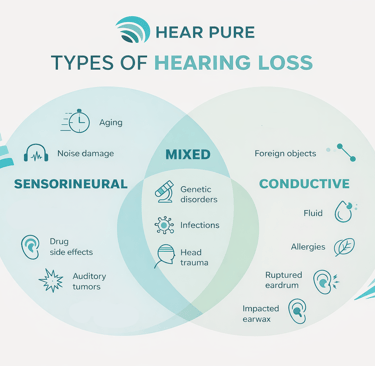
Hearing loss is generally categorised as either conductive hearing loss or sensorineural hearing loss, although it is also possible to experience a combination of both. This distinction matters because each type affects hearing in a different way and responds differently to treatment.
Hearing Loss That Is Usually Reversible
Conductive hearing loss is the type that is most commonly reversible. It occurs when sound is blocked from travelling efficiently through the outer or middle ear. This is often caused by issues such as earwax build-up, fluid behind the eardrum, or inflammation from an infection. Because these problems interfere with sound transmission rather than damaging the hearing nerve itself, hearing can often improve once the blockage is removed or the inflammation settles.
In many cases, hearing returns to normal or near-normal levels after earwax removal, treatment for an infection, natural drainage of fluid, or a minor medical procedure. The earlier conductive hearing loss is identified, the better the outcome is likely to be, which is why prompt assessment plays such an important role.
Hearing Loss That Is Usually Not Reversible
Sensorineural hearing loss is typically not reversible because it involves damage to the inner ear, known as the cochlea, or to the auditory nerve.
This type of hearing loss most commonly develops due to age-related changes, prolonged exposure to loud noise, certain viral infections, or genetic factors. Unlike conductive hearing loss, the issue is not a blockage but damage to the delicate structures that convert sound into signals for the brain.
Although sensorineural hearing loss cannot usually be reversed, it can be managed very effectively with modern hearing solutions. With the right support, many people find that their ability to communicate improves, everyday sounds become clearer, and listening feels far less tiring.
How Can I Determine If My Hearing Loss Is Conductive, Sensorineural or Both?
Start by thinking about how your hearing behaves in everyday situations. When your hearing feels blocked or muffled, ask yourself whether it improves after yawning, swallowing, or once a cold has cleared.
If it does, this can often point towards conductive hearing loss, where sound is being physically blocked in the outer or middle ear.
Now consider whether sounds feel clear but simply too quiet, even when people are speaking directly to you. If turning the volume up helps only a little and speech still feels difficult to understand, this can be more typical of sensorineural hearing loss, which involves the inner ear or hearing nerve.
You may also notice a combination of both experiences. If some sounds feel blocked while others are clear but difficult to follow, this can suggest mixed hearing loss, where more than one part of the hearing system is affected.
These reflections can give you useful clues, but they are not a diagnosis. The only way to accurately determine whether your hearing loss is conductive, sensorineural, or mixed is through a professional hearing assessment.
Hearing tests measure how sound travels through your ears and how your inner ear responds, removing uncertainty and ensuring you receive the most appropriate advice and support.
How Can Modern Hearing Technology Help?
Unfortunately, in some instances, hearing loss is irreversible, but there is still good news. Even when hearing loss cannot be reversed, modern hearing technology can make a significant difference to quality of life.
Today’s hearing aids are designed to improve speech clarity, reduce listening fatigue, and help manage tinnitus.
Research and clinical experience also show that using hearing aids earlier can help the brain adapt more effectively to hearing changes. This often makes hearing feel more natural over time, rather than something that constantly requires extra effort.
When Should You Get Your Hearing Checked?
Ask yourself the following questions:
Are you noticing that your hearing loss has developed gradually rather than suddenly?
Do sounds often feel muffled or unclear, even when people are speaking directly to you?
Do you find it difficult to follow conversations, particularly in busy or noisy environments?
Are you turning the television or radio up louder than others need it to be?
Have you noticed ringing, buzzing, or humming in your ears alongside changes in your hearing?
Do you feel more tired or frustrated after listening for long periods?
If you recognise yourself in one or more of these situations, it may be time to book a professional hearing assessment. You can contact hear pure to receive a hearing assessment to determine whether your hearing loss is reversible, temporary, or best managed with ongoing support. Fill out our form or give us a call at 01244 311142 (Chester) or 0151 342 6325 (Heswall). Do not delay - get clarity, reassurance, and guidance on the most appropriate next steps.
Key Takeaways
Whether hearing loss can be reversed depends on its cause and type.
Conductive and temporary hearing loss can often be restored with the right treatment, while sensorineural hearing loss is usually permanent but highly manageable with modern hearing solutions.
The most important step is understanding what type of hearing loss you have. A professional hearing assessment offers clear answers and a practical path forward, whether that involves treatment, monitoring, or hearing support. If you are concerned about changes in your hearing, seeking advice sooner rather than later can make a meaningful difference.

Address
1A Hoole Rd, Chester CH2 3NQ
1 Milner Road, Heswall, CH60 5RT