sign up for special reductions on ear wax removal

What Is Conductive Hearing Loss?
Experiencing muffled or blocked hearing? Learn what conductive hearing loss is, what causes it, and how it’s usually treated. Read more.
1/22/20263 min read


If sounds feel muffled, distant, or as though your ears are blocked, you may be experiencing conductive hearing loss. This type of hearing loss is very common and, in many cases, temporary and treatable, particularly when it is identified early. Understanding what is happening inside your ears can help you recognise the signs sooner and take the right next step. In this article, we explain what conductive hearing loss means, what causes it, how it is diagnosed, and how it is usually treated.
What Does “Conductive Hearing Loss” Mean?
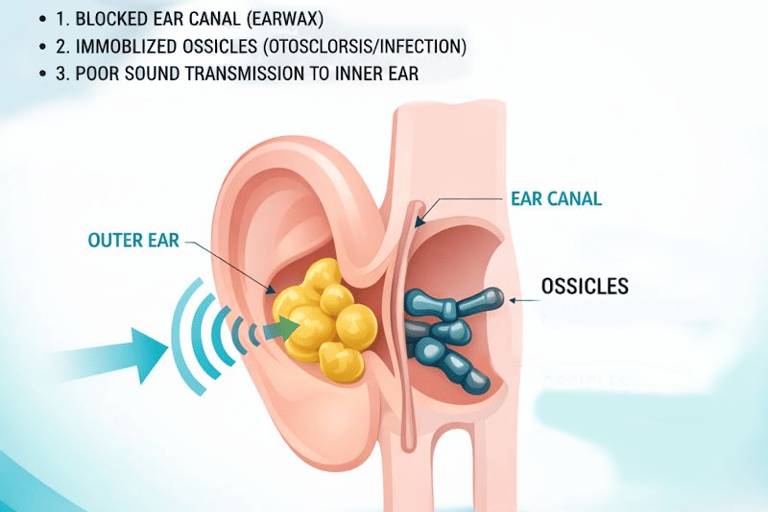
Conductive hearing loss occurs when sound is unable to travel efficiently through the outer or middle ear to reach the inner ear. In simple terms, something is blocking or reducing sound before it reaches the part of the ear that converts sound into signals for the brain.
The key point to understand is that the inner ear and hearing nerve are usually working normally. The issue is not with sound processing, but with how sound is physically conducted through the ear. This distinction is important, because problems affecting sound conduction are often easier to treat.
How Hearing Normally Works (and What Changes)
Under normal conditions, sound enters the ear canal, causes the eardrum to vibrate, and is amplified by tiny bones in the middle ear before reaching the inner ear. This process allows sound to be converted into electrical signals that the brain understands.
With conductive hearing loss, something interferes with this pathway. You can think of it like turning the volume down before sound reaches the speaker, rather than the speaker itself being damaged. This is why sounds may feel quieter, duller, or blocked rather than distorted.
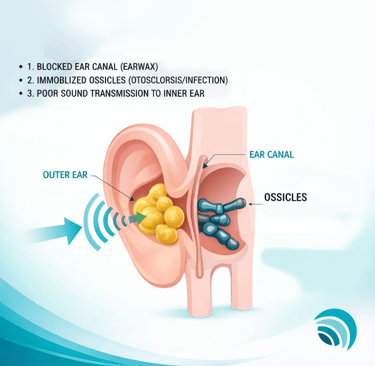
Conductive hearing loss is most often caused by issues that are temporary or reversible. These include earwax build-up blocking the ear canal, middle ear infections that lead to fluid behind the eardrum, glue ear (which is particularly common in children), swelling or inflammation of the ear canal, a perforated eardrum, or problems affecting the small bones of the middle ear.
Because these causes interfere with sound transmission rather than damaging the hearing nerve, hearing often improves once the underlying issue is treated. This is why many people experience a noticeable improvement after the blockage clears or inflammation settles.
What Does Conductive Hearing Loss Sound Like?
To understand whether this might apply to you, think about how your hearing feels day to day. Do sounds seem muffled or dull rather than unclear? Does speech feel quieter, especially in calm environments? You may notice a feeling of fullness or pressure in one or both ears, or find that hearing temporarily improves after yawning or swallowing.
Some people also report that they hear better in noisy environments than in quiet ones, because background noise forces people to speak louder. These experiences can be useful clues, although they are not a diagnosis on their own.
A hearing professional can confirm conductive hearing loss through a combination of tests. These typically include looking inside the ear, measuring hearing levels, and assessing how well the middle ear is functioning. Together, these tests help determine whether hearing loss is conductive, sensorineural, or mixed, and allow the most appropriate treatment plan to be recommended.
Can Conductive Hearing Loss Be Treated?
In most cases, yes. Treatment depends on the cause but often involves professional earwax removal, medication to treat infection or inflammation, monitoring fluid build-up, or minor medical procedures. In some situations, temporary hearing support may be recommended while the ear recovers.
Once the blockage or inflammation resolves, hearing frequently returns to normal or near-normal levels, which is why early assessment makes such a difference.
Conductive hearing loss is rarely permanent when treated promptly. However, if underlying issues are left untreated for long periods, complications can sometimes develop. This is why it is important not to ignore ongoing symptoms, even if they feel mild at first.
When Should You Get Your Hearing Checked?
If your hearing feels blocked or muffled, symptoms last longer than a few weeks, you experience repeated ear infections, or hearing difficulties are affecting daily life, it is a good idea to seek professional advice. Early diagnosis can prevent unnecessary discomfort and support better long-term hearing health.
Final Thoughts
So, what is conductive hearing loss? It is a type of hearing loss caused by a blockage or problem in the outer or middle ear that prevents sound from reaching the inner ear effectively. The reassuring news is that it is often temporary and very treatable.
If you are experiencing symptoms that sound familiar, a professional hearing assessment can identify the cause and help restore your hearing as quickly and comfortably as possible. You can contact Hear Pure to book an assessment or adjustment by filling out our online form, or by calling 01244 311142 for Chester or 0151 342 6325 for Heswall.


Address
1A Hoole Rd, Chester CH2 3NQ
1 Milner Road, Heswall, CH60 5RT